

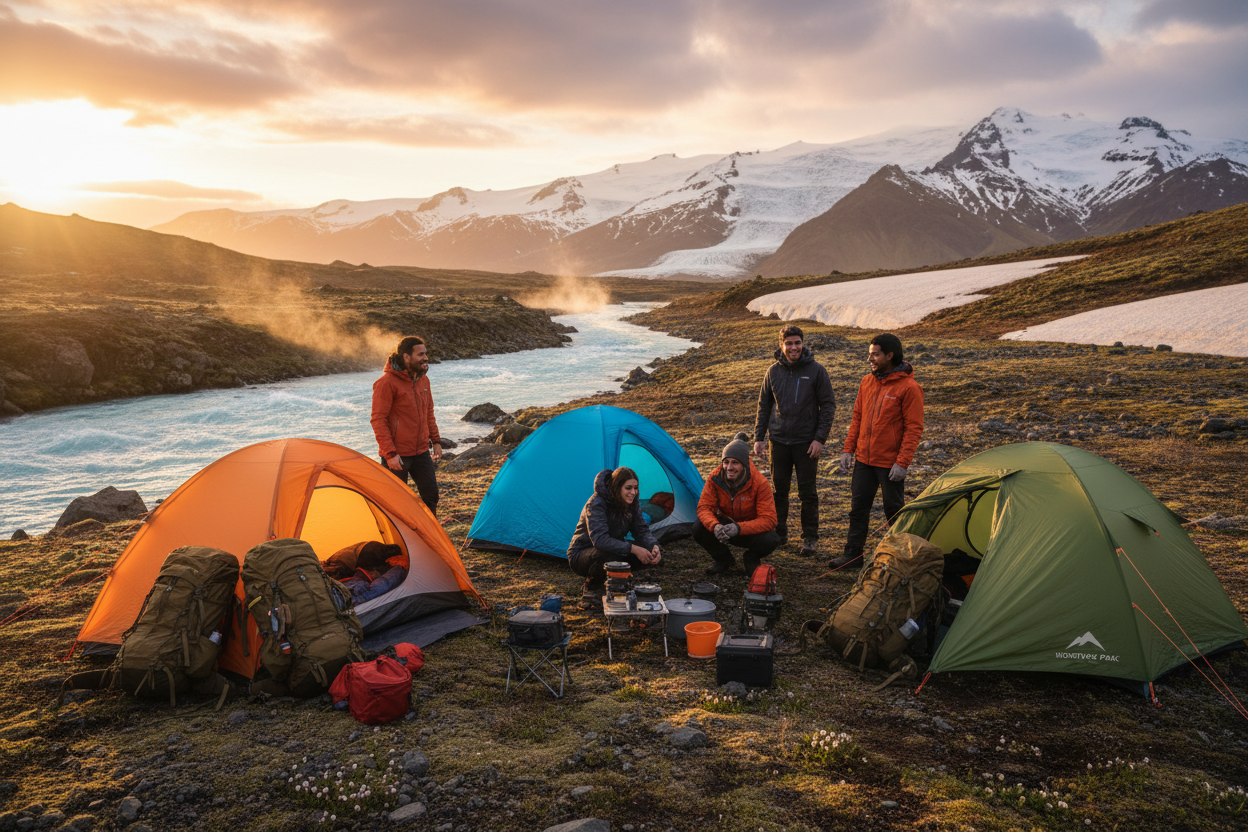
Choosing the right tent for Iceland is about more than just how many people it sleeps. Iceland's notorious wind, rain, and unpredictable weather mean that tent shape, weight rating, and build quality matter just as much as capacity. This guide walks you through everything you need to know to pick the perfect tent for your Iceland camping trip.
Why Tent Choice Matters More in Iceland
Iceland regularly experiences winds of 20–40 km/h, with gusts exceeding 60 km/h in exposed areas. A tent that performs fine in a sheltered European campsite can collapse or leak badly in Icelandic conditions. Before thinking about size, make sure your tent meets these baseline requirements:
- Freestanding design: Dome or geodesic tents hold their shape without relying on guy lines alone — critical on rocky ground where pegs can't always be driven deep.
- Double-wall construction: An inner tent plus a separate flysheet provides far better condensation management and weather protection than single-wall designs.
- Wind rating: Look for tents tested to at least 60 km/h wind resistance. Geodesic tents (with crossing pole structures) are the gold standard for wind resistance.
- Taped seams: Fully taped or factory-sealed seams prevent water ingress during heavy rain.
- Vestibule space: A large porch area lets you store wet gear, boots, and cooking equipment outside the sleeping area but under cover.
Tent Sizes Explained
1-Person Tents
Best for: Solo hikers on the Laugavegur Trail or other multi-day routes where pack weight is critical.
A 1-person tent is the lightest option but offers minimal living space. In Iceland's wet weather, you'll spend time sheltering inside — a 1-person tent can feel very cramped during a rain day. Consider a 1–2 person tent instead if you're a solo traveller who values comfort.
- Typical weight: 1.0–1.8 kg
- Floor area: 1.2–1.8 m²
- Recommended for: Ultralight solo hikers, Laugavegur Trail
2-Person Tents
Best for: Couples, or solo travellers who want extra space for gear and comfort.
The most popular tent size for Iceland. A 2-person tent gives a solo camper room to spread out gear, or fits two people comfortably for a couple's trip. This is the sweet spot between weight and livability for most Iceland campers.
- Typical weight: 1.8–2.8 kg
- Floor area: 2.5–3.2 m²
- Recommended for: Couples, solo campers wanting comfort, most Iceland trips
3-Person Tents
Best for: Groups of 2 who want generous space, or 3 people travelling light.
A 3-person tent is a great choice for two people on a car camping trip where weight isn't a concern. It provides excellent living space for bad weather days and room for gear inside. For three actual people, it's a snug but workable fit.
- Typical weight: 2.5–3.8 kg
- Floor area: 3.5–4.5 m²
- Recommended for: Couples car camping, groups of 3 travelling light
4-Person Tents
Best for: Families, groups of 3–4, or those who prioritise comfort over portability.
A 4-person tent is ideal for families or friend groups doing a Ring Road car camping trip. It provides real living space — you can sit up, change clothes, and store gear without feeling cramped. Not suitable for backpacking due to weight.
- Typical weight: 3.5–5.5 kg
- Floor area: 5.0–6.5 m²
- Recommended for: Families, groups of 3–4, Ring Road car camping
6-Person Tents and Larger
Best for: Large groups, base camp setups, or those wanting a separate sleeping and living area.
Large tents are great for group trips where you're staying in one location for multiple nights. However, large tents can be challenging to pitch in high wind — always use all guy lines and choose a sheltered pitch location.
- Typical weight: 6–12 kg
- Floor area: 8.0–14.0 m²
- Recommended for: Large groups, base camps, multi-night stays at one site
Tent Shape: Dome vs Geodesic vs Tunnel
Dome Tents
The most common tent shape. Two crossing poles create a stable, freestanding structure. Good wind resistance and easy to pitch. The best all-round choice for most Iceland campers.
Iceland verdict: ✅ Excellent choice
Geodesic Tents
Multiple crossing poles create an extremely rigid structure. The best wind resistance of any tent design. Heavier and more expensive, but worth it for exposed highland camping or shoulder season trips.
Iceland verdict: ✅ Best for highlands and exposed sites
Tunnel Tents
Parallel hoops create a long, low profile with excellent interior space. However, tunnel tents are not freestanding — they rely on guy lines for stability. In rocky Icelandic ground where pegs can be hard to set, this is a significant disadvantage.
Iceland verdict: ⚠️ Use with caution — only in sheltered sites with good peg-able ground
Quick Reference: Which Tent Size for Your Trip?
| Trip Type | Recommended Tent Size | Shape |
|---|---|---|
| Solo backpacking (Laugavegur Trail) | 1–2 person | Dome or Geodesic |
| Solo car camping (comfort) | 2–3 person | Dome |
| Couple, backpacking | 2 person | Dome or Geodesic |
| Couple, car camping | 3–4 person | Dome |
| Family of 3–4 | 4 person | Dome |
| Group of 4–6 | 4–6 person | Dome or Geodesic |
| Highland / exposed camping | Any size | Geodesic preferred |
Iceland-Specific Tent Tips
- Always use all guy lines: Even on calm evenings, wind can pick up suddenly overnight. Guy out your tent fully every time.
- Use a footprint/groundsheet: Iceland's rocky and wet ground can damage tent floors. A footprint extends the life of your tent significantly.
- Choose your pitch carefully: Look for natural windbreaks (boulders, hillsides) and avoid low-lying areas that collect water. Never pitch on fragile moss.
- Stake out in rocky ground: Carry rock pegs or use guy lines tied to large rocks if the ground is too hard for standard pegs.
- Ventilate to reduce condensation: Iceland's humidity means condensation builds up quickly inside tents. Keep vents open even in rain to reduce moisture inside.
Rent a Tent for Your Iceland Trip
Not sure which tent is right for you, or don't want to travel with bulky camping gear? Rent a tent from Iceland Camping Equipment. We stock a range of high-quality, Iceland-tested tents in all sizes — from lightweight 1-person backpacking tents to spacious 4-person family tents. All our tents are inspected, cleaned, and ready for Iceland's conditions.
What to rent for this
- 2-person tent
- 3-person tent
- 4-person XXL tent
- Light hiking tent, 2 person — for carrying rather than driving
Frequently Asked Questions
Do I need a 4-season tent for Iceland in summer?
Not necessarily. A high-quality 3-season tent with good wind resistance (dome or geodesic) is sufficient for summer camping in Iceland. For highland camping or shoulder season (May/September), a 4-season or expedition tent provides extra peace of mind.
What size tent do I need for 2 people in Iceland?
A 2-person tent is the minimum for two people. For car camping where weight isn't an issue, a 3-person tent gives you much more comfortable living space for bad weather days.
Can I use a cheap tent in Iceland?
We strongly advise against it. Budget tents often have poor wind resistance, untaped seams, and weak poles. Iceland's weather can destroy a cheap tent overnight. Invest in a quality tent or rent one from us.
How do I pitch a tent on rocky Icelandic ground?
Use rock pegs where possible, or tie guy lines to large rocks. Many Icelandic campsites provide rocks or sandbags for this purpose. A freestanding dome or geodesic tent is much easier to pitch on rocky ground than a tunnel tent.


Leave a comment
This site is protected by hCaptcha and the hCaptcha Privacy Policy and Terms of Service apply.